Former IndustryWeek Editor Perry Pascarella Dies
Perry J. Pascarella, a longtime IndustryWeek editor who guided the brand in its earliest days, died last week. He was 91.
The author of numerous books on faith and management, including “Ten Commandments of the Workplace,” Pascarella was executive editor in 1970 when Steel magazine changed its name and editorial focus, becoming IndustryWeek. He was the brand’s chief editor from 1986 until 1989, when he became vice president at then-parent company Penton Business Media, overseeing all of its publications.
John DiPaola, a vice president with IndustryWeek parent company Endeavor Business Media, worked with Pascarella early in his career and called him a legend in the industry.
“Perry’s influence extended well beyond IndustryWeek,” DiPaola said. “He was widely respected for his humanistic and collaborative management style, an award-winning editor who led by example and brought out the best in those around him. Perry was a staunch advocate for editorial independence and encouraged his journalists to write the truth as they saw it, earning their trust and admiration. He fostered an environment grounded in high standards, open dialogue and mutual respect, where ideas thrived, and people felt both challenged and supported.”
John McClenahen, a former IndustryWeek editor, also stressed Pascarella’s kindness and humanity as defining characteristics.
“He enthusiastically supported my application for Press Fellowship at Wolfson College, Cambridge, in 1986,” McClenahen said. “When I was chosen as the first American to receive the fellowship, Perry secured a three-month, paid sabbatical for me. He did not have to do that. However, he believed deeply in encouraging and valuing people, and I am forever grateful, professionally and personally.”
A graduate of Ohio’s Kenyon College, Pascarella served in the U.S. Naval Reserve before beginning his career as a writer and editor.
He is preceded in death by his wife, Carol. They were together for almost 70 years. He is survived by daughters Elizabeth Ferrito and Cindy and four grandchildren Jack Ferritto (Katrina), Mitchell, Kalli and TJ (Courtney) and three great grandchildren June, Nora and Gracie.
The memorial service will take place at Bay (Ohio) Presbyterian Church on Thursday, July 24, 2025, at 11 a.m. In lieu of flowers, donations can be made to Hospice of the Western Reserve.
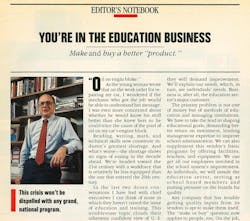
Editor’s note: Pascarella retired many years before I joined IndustryWeek, and while I never worked with him, his hard work in those early years established a tone and structure that has guided us ever since. Below is one of the final things that Pascarella wrote for the brand that he helped launch, an editorial about educational standards from Feb. 6, 1989.
You're in the Education Business
“Oil on engin bloke.”
As the young woman wrote that on the work order for re pairing my car, I wondered if the mechanic who got the job would be able to understand her message. I was even more concerned about whether he would know his stuff better than she knew hers so he could trace the cause of the pool of oil on my car’s engine block.
Reading, writing, math, and technical skills now constitute industry’s greatest shortage. And what’s worse-the shortage shows no signs of easing in the decade ahead. We’re headed toward the 21st century with a workforce that is relatively far less equipped than the one that entered the 20th century.
In the last two dozen conversations I have had with chief executives I can think of none in which they haven’t raised the issue of education and training. This troublesome topic clouds their otherwise confident view of U. S. industry’s future.
Study after study has convinced us that our educational product is inadequate for success in today’s world. There’s little doubt that industry’s most important input—people—is being supplied by the sector that’s doing the poorest—education. Fewer and fewer companies can thrive with the “product” coming to them from our schools. If you think we have productivity and quality problems today, you ain’t seen nothing yet!
So what are we going to do about it? Two things: 1. Ensure that we will be able to hire well-educated people; 2. Improve our on-the-job training and education.
We will make the people aware of the value of education and the coming socioeconomic crisis so they will demand improvement. We’ll explain our needs, which, in turn, are individuals’ needs. Business is, after all, the education sector’s major customer.
The primary problem is not one of money but of methods of education and managing institutions. We have to take the lead in shaping educational goals, demanding better return on investment, lending management expertise to improve school administration. We can also supplement this vendor’s basic programs by offering facilities, teachers, and equipment. We can get all our employees involved in the school system’s improvement. As individuals, we will invade the education sector, serving as school-board members and putting pressure on the boards for quality.
Any company that has trouble getting quality inputs from its vendors is apt to make them itself. The “make or buy” question now applies to people, too. On the job, we will spend more for training and continual retraining at all levels. We will manage our training better. And we’ll go a step further: we’ll engage in remedial education for the thousands of people who need it.
This crisis won’t be dispelled with any grand, national program. None of us can afford to think education is somebody else’s business.
About the Author

Robert Schoenberger
Editor-in-Chief
LinkedIn: linkedin.com/in/robert-schoenberger-4326b810
Bio: Robert Schoenberger has been writing about manufacturing technology in one form or another since the late 1990s. He began his career in newspapers in South Texas and has worked for The Clarion-Ledger in Jackson, Mississippi; The Courier-Journal in Louisville, Kentucky; and The Plain Dealer in Cleveland where he spent more than six years as the automotive reporter. In 2014, he launched Today's Motor Vehicles (now EV Manufacturing & Design), a magazine focusing on design and manufacturing topics within the automotive and commercial truck worlds. He joined IndustryWeek in late 2021.